Midwives: critical in every crisis
To celebrate International Day of the Midwife, we are shining the spotlight on Hilary Alba, Queen’s Nurse and senior charge midwife with the Special Needs in Pregnancy (SNIPS) team at NHS Greater Glasgow and Clyde. Her work demonstrates the essential care that midwives provide — especially in times of crisis.
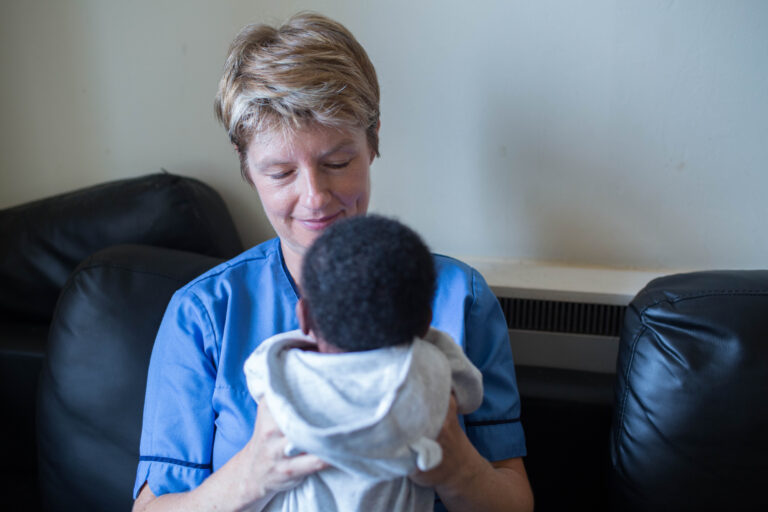
On a wall in her office within Glasgow’s Princess Royal Maternity Hospital, Hilary Alba has hung a large world map. She looks at it from her desk, pinpointing where the women she works with come from. “Syria, Somalia, Iraq, Iran, Albania, Vietnam, and more,” she says. “They are pregnant, traumatised, and many have been abused. It’s my job to make sure that they get all the maternity care and the support they need.”
Hilary is senior charge midwife of the Special Needs in Pregnancy (SNIPS) team, part of NHS Greater Glasgow and Clyde. The team of eight midwives works with homeless women, complex teenagers, people with severe mental health problems, women in the criminal justice system and drug users. Her own specialist field is the care of pregnant asylum seekers, refugees, trafficked women and women who have undergone female genital mutilation (FGM).
When she took up the caseload in March 2016, it was an eye-opener for Hilary. “I had worked in maternity hospitals for years, and never came across cases like these,” she says. “The women I work with now don’t seek out services. We find them and offer a helping hand.”
Hilary, whose first degree was in social anthropology and international relations, decided to train as a midwife when she was in her mid-20s. A student placement took her to the Women’s Reproductive Health Service, set up at Glasgow’s old Rotten Row maternity hospital by campaigning obstetrician Dr Mary Hepburn. “I really liked its focus on female rights and its ethos seemed to complement my interests,” says. “I always hoped that one day I’d be back.”
After she graduated in 2001, Hilary worked as a midwife across Glasgow, married, and had three children of her own. Then her dream job came up. “We are doing the best we can to improve women’s lives through SNIPS,” says Hilary. “It’s the most rewarding thing you can do.”
You might also like…

QNIS invited to a celebration of carers at Windsor Castle